
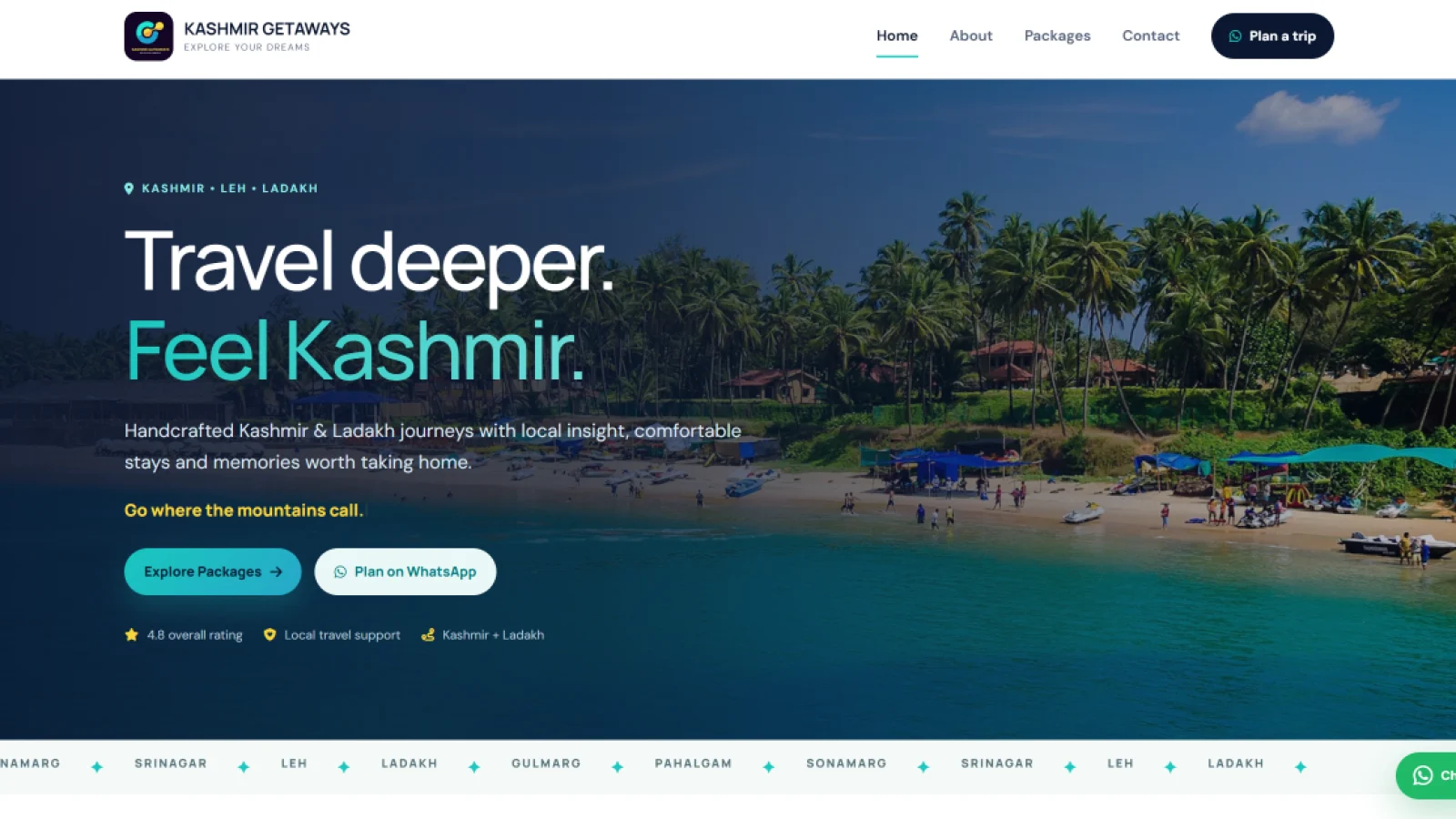
<p>Travel websites have a unique challenge: they need to inspire people to travel while also giving them enough practical information to make a booking decision. A beautiful hero section alone is not enough. Visitors need to quickly understand where they can go, what a package includes, how much planning is involved, how to contact the travel company, and what happens after they submit an enquiry.</p> <p>For <strong>Kashmir Getaways</strong>, we approached the website as more than a simple tourism website. The goal was to create a complete digital experience for a travel agency specializing in <strong>Kashmir, Leh and Ladakh tours</strong>, while keeping the platform lightweight, responsive, SEO-friendly and easy to maintain.</p> <p>At <strong>SuperDevs</strong>, we designed and developed the website around three core objectives: <strong>build trust, make trip discovery simple, and turn website visitors into genuine travel enquiries</strong>.</p> <p>The final website brings together a custom visual identity, responsive package cards, detailed package pages, day-wise itineraries, enquiry forms, WhatsApp integration, responsive galleries, SEO-focused page structures and secure server-side form processing.</p>
Why a Travel Website Needs More Than a Beautiful Design
Travel is an emotional purchase. Before someone books a holiday, they are imagining the destination, comparing options, checking prices, thinking about accommodation, considering transportation and looking for a travel company they can trust.
That makes the website experience especially important for a travel agency. A visitor who cannot quickly find the right package may leave the website. A visitor who finds a package but cannot easily enquire may never become a lead. And a visitor who finds useful information but does not trust the company may continue searching elsewhere.
For Kashmir Getaways, our approach was therefore to combine visual storytelling with practical travel information and strong conversion paths.
Instead of treating every page as an isolated design, we created a connected journey:
- Discover Kashmir Getaways through the homepage.
- Explore Kashmir, Leh and Ladakh travel packages.
- Open a package to view detailed information.
- Review the day-wise itinerary and highlights.
- Ask questions through the enquiry form.
- Contact the agency directly through WhatsApp.
- Submit a booking enquiry without leaving the website.
This approach helped us build the website around the actual behavior of a travel customer rather than simply creating a collection of attractive pages.
Creating a Visual Identity Around the Kashmir Getaways Brand
The existing Kashmir Getaways logo provided the foundation for the visual direction. Its combination of cyan, blue, yellow and orange naturally suggested a vibrant travel-oriented identity.
However, using every brand color everywhere can quickly make a website feel overwhelming. We therefore developed a more controlled color system around the logo.
The primary interface uses clean, light backgrounds supported by deep navy typography, while cyan and blue provide interactive accents. Yellow and warm orange are used selectively to highlight important actions and travel-related visual elements.
This creates a balance between the energy expected from a tourism brand and the professionalism users expect from a company handling their travel plans.
The result is a visual language that feels bright, modern, trustworthy and destination-focused without looking like a generic Bootstrap template.
Designing a Homepage That Starts the Travel Journey
The homepage was designed to answer the most important visitor questions quickly.
Rather than using a generic full-screen hero that consumes the entire mobile viewport, we created a more practical hero experience that introduces the brand, communicates the travel proposition and gives visitors clear next steps.
The homepage uses a combination of:
- Brand-focused hero messaging.
- Animated typing text for travel-oriented messages.
- Clear calls to action.
- Featured travel packages.
- Destination-focused content.
- Trust and service highlights.
- Travel experience sections.
- Customer-oriented enquiry paths.
- WhatsApp contact access.
The typing effect was intentionally kept subtle. Instead of becoming a distraction, it adds movement to the hero while allowing the primary message and call-to-action to remain clear.
Building a Reusable Package System
One of the most important technical decisions was to avoid hard-coding every package page separately.
The package content is maintained through a central package data structure. This allows package cards, package detail pages and booking interactions to use the same underlying information.
A package can contain information such as:
- Package title.
- SEO-friendly slug.
- Destination or region.
- Duration.
- Location.
- Price information.
- Primary image.
- Gallery images.
- Description.
- Highlights.
- Day-wise itinerary.
This reusable architecture makes it much easier to expand the website as Kashmir Getaways adds more travel products.
Instead of building another page from scratch for every new tour, the same presentation system can be reused with new package information.
Making Package Discovery Easier
A travel agency can offer many combinations of destinations and durations. If all packages are displayed in one undifferentiated list, users have to work too hard to find something relevant.
We therefore introduced package categorization and filtering so visitors can explore trips according to destination or region.
This creates a more structured discovery experience while also giving the website a scalable foundation for future categories such as:
- Kashmir Tours
- Leh Ladakh Tours
- Family Packages
- Honeymoon Packages
- Adventure Tours
- Short Getaways
- Custom Tours
The important part is that the package system can grow without requiring a redesign of the entire website.
Designing the Package Detail Experience
The package detail page is where a visitor moves from inspiration to serious consideration.
For that reason, we designed the page to provide the information needed before making an enquiry.
Each package detail page can present a visual gallery followed by an overview, highlights, detailed itinerary and frequently asked questions.
The gallery uses a responsive Swiper-based slider so visitors can browse multiple destination images without leaving the page.
We also paid particular attention to image sizing and responsive behavior. Large travel images can easily create layout problems on smaller screens, so the gallery container and images were designed to remain contained within the available content width.
Day-Wise Itineraries for Better Travel Planning
A major part of the package experience is the itinerary.
Travelers often want to understand what each day actually looks like before they submit an enquiry. A simple paragraph such as “6 days in Kashmir” does not provide enough information.
We therefore created a structured day-wise itinerary presentation.
Each day contains:
- The day number.
- A descriptive title.
- The planned activities.
- Supporting information about that part of the journey.
This makes complex travel plans much easier to scan and gives visitors a clearer understanding of what they are considering.
Designing for Mobile Travelers
Responsive design was not treated as an afterthought.
Travel users frequently discover destinations and travel companies through mobile devices, which means the website needs to work particularly well on smaller screens.
During development, we paid attention to mobile-specific issues such as:
- Navigation behavior.
- Hamburger menu interactions.
- Modal positioning.
- Package card widths.
- Image and gallery dimensions.
- Form field sizing.
- Floating WhatsApp controls.
- Mobile package booking actions.
- Readable typography.
- Spacing between interactive elements.
On package detail pages, a dedicated mobile booking action provides a convenient way to enquire without forcing the user to scroll back through the entire page.
Turning Website Visitors Into Enquiries
A travel website ultimately needs to generate conversations.
For Kashmir Getaways, we created enquiry paths that allow users to choose between submitting a website form and starting a WhatsApp conversation.
The booking modal automatically receives the selected package name when a visitor clicks Book Now. This removes unnecessary typing and gives the travel team useful context about what the visitor is interested in.
The enquiry can include:
- Name.
- Email address.
- Phone or WhatsApp number.
- Preferred travel dates.
- Selected package.
- Additional travel requirements.
This creates a much more useful lead than a generic “Contact us” form because the travel team already knows which package the visitor was viewing.
WhatsApp as a Direct Booking Channel
For many travel businesses, WhatsApp is one of the fastest ways to communicate with potential customers.
Instead of hiding the WhatsApp option somewhere in the footer, we integrated it throughout the user journey.
Visitors can access WhatsApp from contact areas, package pages, booking interfaces and the floating WhatsApp button.
Package-specific WhatsApp links also pre-fill a message containing the selected package. This makes the conversation easier to start and gives the travel coordinator immediate context.
Secure Enquiry Form Processing with PHP
The website uses server-side PHP processing for enquiry submissions.
Because public forms can attract automated spam, we implemented multiple layers of protection rather than relying on a single mechanism.
The form workflow includes:
- CSRF token validation.
- Honeypot anti-spam protection.
- Session-based submission rate limiting.
- Email validation.
- Input length validation.
- Escaped output.
- Server-side validation.
Successful enquiries are sent using PHPMailer with SMTP, allowing the website to use authenticated mail delivery instead of relying on a basic PHP mail configuration.
This provides a more reliable foundation for business enquiry notifications and keeps email delivery separate from the frontend interface.
SEO Was Built Into the Website Structure
Search engine optimization was considered during the information architecture and content development rather than being added only after the website was finished.
Individual pages use descriptive titles, meta descriptions and canonical URLs. Package pages also have unique content based on the destination, duration, highlights and itinerary.
The website architecture provides dedicated pages for important areas including:
- Home.
- About Kashmir Getaways.
- Travel Packages.
- Individual Package Details.
- Contact.
- Privacy Policy.
- Terms and Conditions.
This gives search engines clear page-level signals while giving visitors dedicated landing pages for different stages of their travel research.
Creating SEO-Friendly Travel Content
Tourism SEO is not simply about repeatedly using words such as “Kashmir tour package.” Search engines and users both benefit from content that genuinely answers travel-related questions.
For Kashmir Getaways, content opportunities include information around destinations, travel planning, itineraries, seasonal considerations, sightseeing and different types of Kashmir and Ladakh tours.
By creating useful destination and package content, the website has a foundation that can continue to grow organically over time.
Keeping the Technology Lightweight
The website was built using a practical technology stack rather than introducing unnecessary complexity.
The core implementation uses:
- PHP for server-side rendering and application logic.
- HTML5 for semantic page structure.
- CSS3 for the custom visual system and responsive layouts.
- JavaScript for interactive behavior.
- Bootstrap for selected utility and component functionality.
- Swiper for responsive travel galleries.
- Font Awesome for interface icons.
- PHPMailer for authenticated SMTP email delivery.
Although Bootstrap is available in the project, the visual design does not depend on the default Bootstrap appearance. Custom CSS handles the majority of the visual styling so the website feels like a purpose-built travel brand rather than a pre-made template.
Security and Deployment Considerations
A production website needs more than attractive pages. We also considered basic security and deployment requirements during development.
The project uses configuration-based site URLs and contact information, escaped public output, protected form processing and server configuration through .htaccess.
Development also involved testing the website across different deployment environments, including a subdirectory installation and the final main-domain deployment.
This highlighted an important practical lesson: paths that work perfectly on a local machine or development subdirectory can behave differently when the website moves to the root domain.
Using centralized URL helpers and consistent asset paths makes deployment considerably easier and reduces broken links between package cards, images, forms and detail pages.
Building a Maintainable Travel Website
Another important goal was maintainability.
A travel agency website is rarely finished forever. Packages change, destinations are added, prices are updated, images are replaced and new services are introduced.
For that reason, we structured the project so common elements are reused across the website.
Shared components such as the header, footer, package data and configuration are separated from individual page content.
This means a change to a common component does not require manually editing every page.
What We Learned From the Project
Building the Kashmir Getaways website reinforced several principles that apply to almost every service-based business website.
1. Design should support the business goal
A website can look impressive and still perform poorly if visitors cannot figure out what to do next. Every major section should support discovery, trust or conversion.
2. Mobile design needs independent attention
A desktop layout cannot simply be compressed onto a phone. Navigation, forms, galleries, buttons and floating actions all need to be reconsidered for smaller screens.
3. Content is part of the product
For a travel company, package information and itinerary details are not filler. They are an important part of the buying experience and can also create valuable organic search opportunities.
4. Enquiries should carry context
A booking enquiry that already contains the package name, dates and customer details is much more useful than a generic message that simply says “I want information.”
5. Security should be considered from the beginning
Public enquiry forms need protection against automated submissions and malformed input. Basic measures such as CSRF protection, honeypots, rate limiting and server-side validation provide an important security foundation.
The Result
The completed Kashmir Getaways website brings together branding, travel content, package discovery and lead generation in a single responsive experience.
Visitors can move from discovering the brand to exploring destinations, comparing packages, reading detailed itineraries and contacting the travel team without unnecessary friction.
From a development perspective, the project also provides a scalable foundation for future packages, new destination content and additional travel services.
Most importantly, the website was designed around the actual needs of a travel business: inspire visitors, establish trust, provide useful information and make it easy to start a conversation.
Looking to Build a Travel Website?
A successful tourism website needs more than destination photographs and a contact number. It needs a clear information architecture, compelling content, responsive design, strong calls to action, reliable enquiry handling and a technical foundation that can grow with the business.
At SuperDevs, we build websites around the specific goals of the businesses they represent. For travel companies, that can include package management, destination pages, enquiry systems, WhatsApp integration, SEO-focused content structures, responsive galleries and custom booking experiences.
If you are planning a website for a travel agency, tour operator, hotel or tourism business, talk to SuperDevs about creating a modern digital experience designed around your customers and business goals.
Great travel websites do not just show people where they can go. They help people imagine the journey, understand the experience and take the first step toward booking it.